First-Time Home Buyer in Winston-Salem, NC
Most first-time buyers come in not knowing what they don't know. That's normal. The process has real steps, real timelines, and real decisions — and the ones who go in prepared tend to close with fewer surprises and less stress. Rob Herald Realty works with first-time buyers across the Winston-Salem metro and Forsyth County area. No condescension, no pressure. Just a clear picture of what buying your first home actually involves.

Buying your first home — what actually happens between now and closing
Most first-time buyers have seen enough real estate content to know that houses are listed on Zillow, that there's something called an inspection, and that you need a down payment. The part most of them don't have a clear picture of is what happens between 'I want to buy a home' and 'I have the keys.' That gap is where the mistakes happen.
1Get Pre-Approved Before You Look at Anything
Pre-approval is not the same as pre-qualification. Pre-qualification is a rough estimate based on self-reported information. Pre-approval means a lender has reviewed your income, credit, and assets and issued a letter stating how much they'll lend. Sellers in the Winston-Salem market expect a pre-approval letter with any competitive offer. Shopping for homes without one wastes your time and the agent's.
2Understand What Your Budget Actually Gets You
Your pre-approval letter tells you the maximum you can borrow. That number is not your target — it's your ceiling. The right purchase price accounts for your monthly payment after taxes, insurance, and HOA if applicable, your reserves for maintenance and repairs, and your ability to absorb an unexpected expense without financial stress. Rob's first conversation with every first-time buyer includes a realistic breakdown of what their budget delivers in the current Forsyth County market — not what the mortgage calculator says, what buyers are actually finding.
3Work With an Agent Who Represents You
The seller's agent represents the seller. The listing agent's job is to get the highest price and best terms for the person selling the house. As a buyer, you need your own representation — an agent whose fiduciary duty runs to you, not to the transaction. Rob represents buyers exclusively on the buyer side. His job is to tell you the truth about a property, negotiate on your behalf, and help you avoid a mistake — not to close a sale.
4Search Based on Needs, Not Photos
Online listings are curated. Wide-angle lenses make small rooms look large. Filters don't show road noise, drainage issues, or a neighbor's property conditions. The homes that look best online are not always the best buys. Rob's approach with first-time buyers is to search based on the criteria that actually matter — lot, location, layout, systems, and condition — and walk in ready to evaluate what the photos couldn't show.
5Make an Offer That Reflects the Market
In the Winston-Salem area, well-priced homes in desirable communities can still move quickly. First-time buyers who've never written an offer often don't understand what terms actually matter — not just price, but due diligence period length, closing timeline, what's included, and how to structure contingencies. Rob walks buyers through every element of an offer before anything is submitted.
6Use the Due Diligence Period Correctly
North Carolina uses a due diligence period — a window of time during which the buyer can investigate the property, order inspections, review HOA documents if applicable, and walk away for any reason. This period protects the buyer. Buyers who skip inspections or rush through due diligence to save money often spend significantly more fixing problems that a $400 inspection would have identified. Rob recommends a general inspection, plus additional specialty inspections (radon, crawl space, HVAC) when warranted.
7Understand What Happens at Closing
North Carolina real estate closings are handled by a closing attorney — not a title company, as in some other states. The closing attorney reviews the title, manages the funds, and records the deed. Buyers should receive a Closing Disclosure at least three business days before closing that shows exactly what they'll owe at the table. Rob reviews this document with buyers before closing day so there are no surprises.
What first-time buyer budgets deliver in the Winston-Salem area right now
Budget conversations based on general national averages don't help buyers in a specific market. The Winston-Salem metro has its own pricing dynamics — different from Charlotte, different from Raleigh, and different from what a national real estate article suggests. Here is what first-time buyers are generally finding at common price points in this area right now.
Under $250,000
This range exists but requires patience, realistic expectations, and a strong lender. Buyers at this level are looking at smaller homes, older construction, more cosmetic updates needed, and limited inventory in the most in-demand communities. Townhomes and condos sometimes open at this price point. The buyers who succeed here know the difference between 'needs paint' and 'needs systems work' — and move quickly when the right property appears.
$250,000 – $350,000
The most competitive bracket for first-time buyers in Forsyth County. Inventory is more meaningful here, but so is competition from other buyers. Established neighborhoods in Kernersville and some Winston-Salem areas deliver reasonable value at this level. Move-in ready homes in desirable communities move quickly — buyers who aren't pre-approved and ready to act will lose homes they wanted.
$350,000 – $450,000
This range gives first-time buyers more options and a little more time. Better condition, more communities, some new construction options in areas like Kernersville. Buyers in this range should still be prepared to move, but the frantic pace of the lower tiers eases somewhat. Lewisville becomes a realistic conversation at the right end of this range.
$450,000+
At this level, first-time buyers have meaningful choices across most communities in Rob's service area — though 'first-time buyer' at this price point usually means a household with established income, a significant down payment, or both. The process is the same; the options are broader. Lewisville, Advance, and the golf course communities become realistic comparisons.
* Ranges vary by specific community, condition, and timing. Rob provides a current market analysis for any buyer's specific price point at no cost.
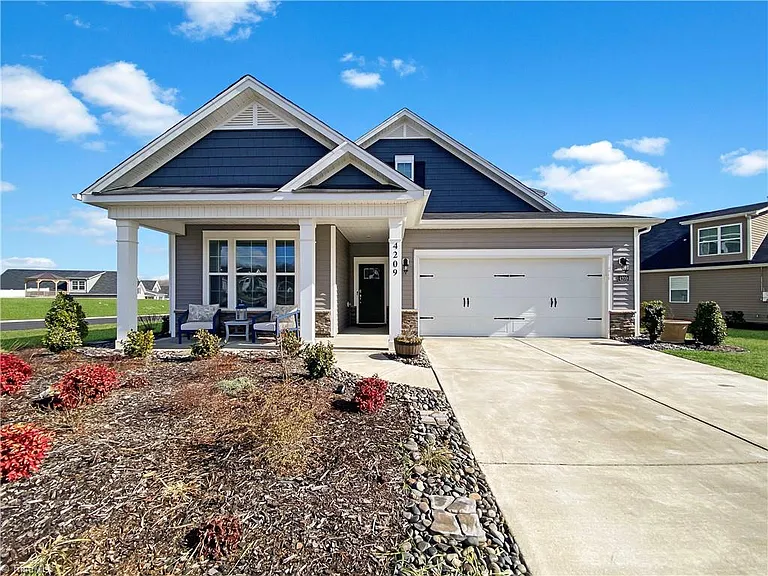
A Home Rob Helped a First-Time Buyer Close On
North Carolina programs that help first-time buyers — what's actually available
North Carolina has genuine first-time buyer assistance programs — not marketing language, actual programs with real eligibility criteria and real money. Most buyers don't find out about them until they're already in contract, which is too late to plan around them. Rob's lender conversations with first-time buyers always include a review of what's available before the search starts.
NC Home Advantage Mortgage
The North Carolina Housing Finance Agency's flagship program for first-time buyers. Offers a 30-year fixed-rate mortgage at competitive rates for buyers who meet income and purchase price limits. Available through participating lenders across Forsyth County and the broader Winston-Salem metro. Rob works with lenders who are approved for this program and can connect buyers to the right conversation.
NC 1st Home Advantage Down Payment
A down payment assistance program paired with the NC Home Advantage Mortgage. Provides up to a set amount in down payment help — forgivable over time as long as the buyer remains in the home. For buyers who have the income to qualify for a mortgage but are struggling with the upfront costs, this program can meaningfully change what's accessible at a given price point.
Before any buyer search starts, Rob recommends a consultation with a lender who knows these programs well — not a generic lender who processes mortgage applications, but someone who actively works with NCHFA and understands the full picture of what's available. The lender conversation should happen before the house search, not during it.
Note: Always verify current terms, income limits, and eligibility directly at nchfa.com.
Federal Programs — FHA, USDA, VA
FHA Loans
Available to first-time buyers with lower credit scores and smaller down payments. Require mortgage insurance premium (MIP), which increases the monthly payment. Often the right tool at the right price point — but buyers should understand the full cost of MIP before assuming FHA is the cheapest path.
USDA Loans
Available for homes in eligible rural and semi-rural areas — which includes parts of the Winston-Salem metro's outer communities. Zero down payment for buyers who meet income limits. Worth asking about if the search extends toward Rural Hall, East Bend, or Yadkin County.
VA Loans
For eligible veterans and active-duty service members. Zero down payment, no PMI, competitive rates. If you're eligible, this is almost always the best loan available. Rob works with VA-approved lenders and can connect buyers to that conversation.
What goes wrong — and how to avoid it
Rob has worked with enough first-time buyers to know where the mistakes cluster. Most of them are not about bad decisions — they're about incomplete information at the wrong moment. Every item on this list is something Rob covers in the first consultation so buyers don't learn it the expensive way.
1. Falling in love with photos before seeing the property
Listing photos are a marketing tool. Wide-angle lenses, bright lighting, and a fresh coat of paint can make a problem property look appealing and a great property look underwhelming. The home that photographs worst on a Tuesday afternoon may be the best buy in the neighborhood. Rob's instruction to every first-time buyer: form your opinion in person, not on a screen.
2. Shopping at the top of the pre-approval number
The maximum loan amount on a pre-approval letter is not a spending target. It's a ceiling calculated by a lender based on debt ratios — it does not account for property taxes, insurance, HOA, maintenance reserves, or lifestyle. Buying at the top of pre-approval often leaves buyers financially thin from day one. Rob asks every buyer to identify their comfortable payment before any search starts.
3. Skipping or limiting inspections to save money
A general home inspection in the Winston-Salem area typically costs $350 to $500. A failing HVAC system costs $5,000 to $15,000 to replace. A crawl space encapsulation runs $3,000 to $8,000. A new roof is $10,000 to $20,000. The math on skipping a $400 inspection to save money does not work in the buyer's favor. Rob recommends a full general inspection plus any specialty inspections warranted by the property's age, type, or condition.
4. Making a major financial change before closing
Between pre-approval and closing, nothing about a buyer's financial profile should change. No new credit cards. No new car loans. No large cash deposits that can't be documented. Lenders re-verify employment, credit, and assets before closing — a new car loan or an unexplained deposit can cause a loan to fall through days before closing day. Rob covers this in the first consultation because it's one of the most avoidable ways a deal dies.
5. Assuming a listing's school information is accurate
School assignments in Forsyth County can change. A listing's school field is populated by the seller and is not guaranteed. If school assignment is a factor in a buyer's decision, Rob verifies it directly with the school system before any offer is made — not after.
6. Letting emotion override the inspection
By the time a buyer reaches inspection, they've often mentally moved in. The inspection comes back with a list of items — some significant, some cosmetic — and the emotional buyer's instinct is to accept everything and move on. That instinct is expensive. Rob reviews inspection reports with every buyer and helps them evaluate which items to negotiate, which to accept, and which should prompt a serious reconsideration.
7. Not understanding what's negotiable in North Carolina
North Carolina real estate contracts are different from contracts in other states. The due diligence fee, the earnest money, the due diligence period length, closing cost contributions, and repair negotiations all work differently here than a buyer coming from another state might expect. Rob explains the NC-specific contract structure at the first consultation so buyers aren't learning it mid-offer.
What to look for in a first-time buyer's agent
On any home purchase, the buyer's agent should be working for the buyer. On a first purchase, that matters more — because the buyer doesn't yet know what questions to ask, what to look for in a property, what to negotiate, or when something is a problem. An experienced buyer's agent fills that gap. An inexperienced one, or one whose interests are misaligned with the buyer's, costs more than their commission is worth.
What Rob Does Differently for First-Time Buyers
Free buyer consultation before any search starts
We don't meet at a house first. We meet at the office or on a call to review the market, set the budget reality, and build a strategy.
Honest property assessments
If a house has a structural issue, a bad roof, or sits on a terrible lot, Rob points it out. The goal is a solid investment, not a fast closing.
Full explanation of every document before signing
North Carolina contracts are legally binding the moment they are signed. You will understand exactly what your obligations and outs are.
Lender introductions to the right people
Not all lenders understand NC housing programs or local dynamics. Rob connects buyers with professionals who process loans cleanly and on time.
Available after closing
When the HVAC acts up six months later or you need a contractor recommendation, Rob remains your resource. The relationship doesn't end at the closing table.
Which communities tend to fit first-time buyer budgets and priorities
The Winston-Salem metro offers first-time buyers meaningful options across a range of communities — each with a different character, commute profile, and price point. What fits one buyer's budget and lifestyle may not fit another's. The best starting point is understanding your priorities, then matching them to the right community.
Not sure which area fits your budget and lifestyle? The Community Area Matcher asks 7 questions and covers all of Rob's service areas.
Take the Area MatcherQuestions first-time buyers ask Rob
How do I know if I'm actually ready to buy, or if I'm just tired of renting?
You are ready when you have a stable income, a clear picture of your budget including maintenance, and the intent to stay in the home for at least three to five years. Renting makes sense if you need flexibility. Buying makes sense when you want fixed housing costs and are prepared for the responsibility of repairs.
What's the first thing I should actually do?
Speak with a local lender to get a true pre-approval, not an online pre-qualification. A local lender reviews your actual financials and tells you exactly what you can borrow and what your monthly payment will be. That anchors the entire search in reality.
How much should I actually budget for a first home — beyond the down payment?
In addition to your down payment, budget 2% to 4% of the purchase price for closing costs (attorney fees, lender fees, taxes). Also, hold back $2,000 to $5,000 for immediate post-move expenses and a general emergency fund. Never empty your bank account at the closing table.
What does a buyer's agent actually do for me, and do I have to pay them?
A buyer's agent represents your financial and legal interests, negotiates the contract, and guides you through due diligence. In North Carolina, the seller typically pays the listing firm, which then splits the commission with the buyer's firm. You sign a Buyer Agency Agreement that outlines this structure before making an offer.
How do I know if a house is priced fairly?
We pull comparable sales — recent, similar homes that have closed in the same neighborhood. We look at condition, market time, and terms. Fair pricing is based on hard data, not what the seller hopes to get.
What happens during due diligence in North Carolina?
You pay a non-refundable due diligence fee directly to the seller for the right to inspect the property. You hire inspectors, review the reports, and decide whether to proceed, negotiate repairs, or walk away. If you walk away during this period, you lose the fee but keep your earnest money.
What should I look for in an inspection report?
Look for structural issues, water intrusion, failing HVAC systems, older roofs, and electrical problems. Ignore cosmetic issues like paint colors or old carpet. Focus on items that cost thousands to fix or present safety hazards.
Should I buy new construction or an established home as a first-time buyer?
New construction offers warranties and less immediate maintenance, but usually sits on smaller lots and commands a premium price. Established homes often have larger lots and mature trees, but require closer attention to the age of the systems (roof, HVAC). It depends entirely on your budget and tolerance for maintenance.
Can I buy a home if I have student loan debt?
Yes. Lenders look at your debt-to-income ratio (DTI), not just the total amount of debt. If your income supports both your student loan payments and a mortgage payment within the lender's guidelines, you can buy a house.
What's the biggest mistake you see first-time buyers make in this market?
Shopping at the absolute top of their pre-approval limit, leaving zero buffer for maintenance or lifestyle changes. The bank tells you what you can technically borrow; you have to decide what you can comfortably pay.
Ready to start your first home search?
The first conversation costs nothing and carries no obligation. It's a chance to understand what your budget actually delivers in this market, what the process looks like from here to closing, and whether the timing is right. Most first-time buyers leave that conversation with a clearer picture of what comes next — and a realistic sense of what they're working with. Tell Rob where you are in the process. He'll give you an honest read on what the next step should be.
Or call Rob directly: (919) 656-4500